

Drug test kits in South Africa: which to buy and how to read them
Home drug test kits cost R79.99 to R119.99 at Dis-Chem and Clicks. What a 5 panel test checks and misses, how to read the lines, how accurate it is, and what to do with a positive.

A home drug test kit costs R79.99 or R119.99 at Dis-Chem and R99.99 at Clicks, as listed on 5 October 2026. Each one screens urine for five drugs in a few minutes, and a positive still has to be confirmed by a laboratory (FDA). In the Western Cape, tik was the main drug for 30% of people in specialist treatment in July to December 2024 (SACENDU), and the Clicks kit and Dis-Chem’s Medic panel both screen for it.
Holding a result and not sure what it means? Message our team in Cape Town for a free, confidential call. We reply the same day.
Drug test kits in South Africa: what Dis-Chem and Clicks sell, and for how much
Dis-Chem sells two five-panel urine kits at R79.99 and R119.99, and Clicks sells one at R99.99, as listed on 5 October 2026. All three are single-use screening tests you can buy off the shelf without a prescription.
Searching the Dis-Chem site for a drug test can confuse you: its Drug Test category shows 6 results, but only two of them test for drugs. The others are breathalysers. The three kits side by side:
| Kit | Shop and price | How it works | Drugs on the panel |
|---|---|---|---|
| Medic 5-drug Test Panel (dip) | Dis-Chem, R79.99 | Strip dipped in a cup of urine | Opiates (MOP), cocaine (COC), amphetamine (AMP), methamphetamine or tik (MET), cannabis (THC) |
| Homemed 5 Panel Device | Dis-Chem, R119.99 | Dip card in urine | Amphetamine (AMP), cocaine (COC), cannabis (THC), ecstasy (MDMA), opiates (OPI) |
| Clicks 5-Drug Multitest | Clicks, R99.99 | One cassette, drops of urine | Cocaine (COC), tik (mAMP), ecstasy (MDMA), heroin (OPI), dagga (THC) |
The Clicks box names ecstasy, but the cut-off table on its insert lists cocaine, methamphetamine, amphetamine, morphine and cannabis, with no separate line for MDMA. If ecstasy is the worry, the Homemed card lists MDMA as its own drug.
Bigger panels are sold online rather than in the pharmacy aisle. One first-aid supplier lists a 12-panel cup at R128.00, a collection cup with the strips built in. More panels cost little more, so a wider cup makes sense when you do not know what you are looking for.
What does a 5 panel drug test check for, and what does it miss?
A 5 panel test checks for cannabis, cocaine, opiates such as heroin, and amphetamines or tik. It does not check for alcohol, mandrax, CAT or benzodiazepines such as Xanor, and a family that suspects one of those can get a clean strip while the problem carries on.
“A cup test does not test for Kat or mandrax, unless stated on the cup,” the Lancet Laboratories guide to drug testing (2015) warns. The same guide notes that with nyaope “the content will vary between different areas and between different suppliers”, so a standard panel is no reliable check for it either. If mandrax or CAT is what you are worried about, our pages on what mandrax is and CAT in South Africa describe the signs to look for.
Alcohol is the other blind spot. It was the main substance for 22% of people in Western Cape specialist treatment in July to December 2024, close behind cannabis at 23% (SACENDU), and it appears on none of the pharmacy panels. A breathalyser shows drinking only for the hours afterwards.
What each code on the strip stands for, AMP, MET, OPI, BZO and the rest, is laid out in drug test results explained.
How does a home drug test kit work?
A home kit is a strip of antibodies that react with a drug or its breakdown product in urine. If the level is above a set cut-off, the test line for that drug stays blank. Below the cut-off, a line appears. The kit answers “above or below the cut-off”, not “how much”.
The cut-offs printed on the Clicks insert show how different the bar is for each drug:
| Code | What it detects | Cut-off (ng/ml) |
|---|---|---|
| THC | Cannabis breakdown product | 50 |
| COC | Benzoylecgonine, the cocaine breakdown product | 300 |
| MET | Methamphetamine (tik) | 1000 |
| AMP | Amphetamine | 1000 |
| MOR | Morphine, standing in for opiates | 2000 |
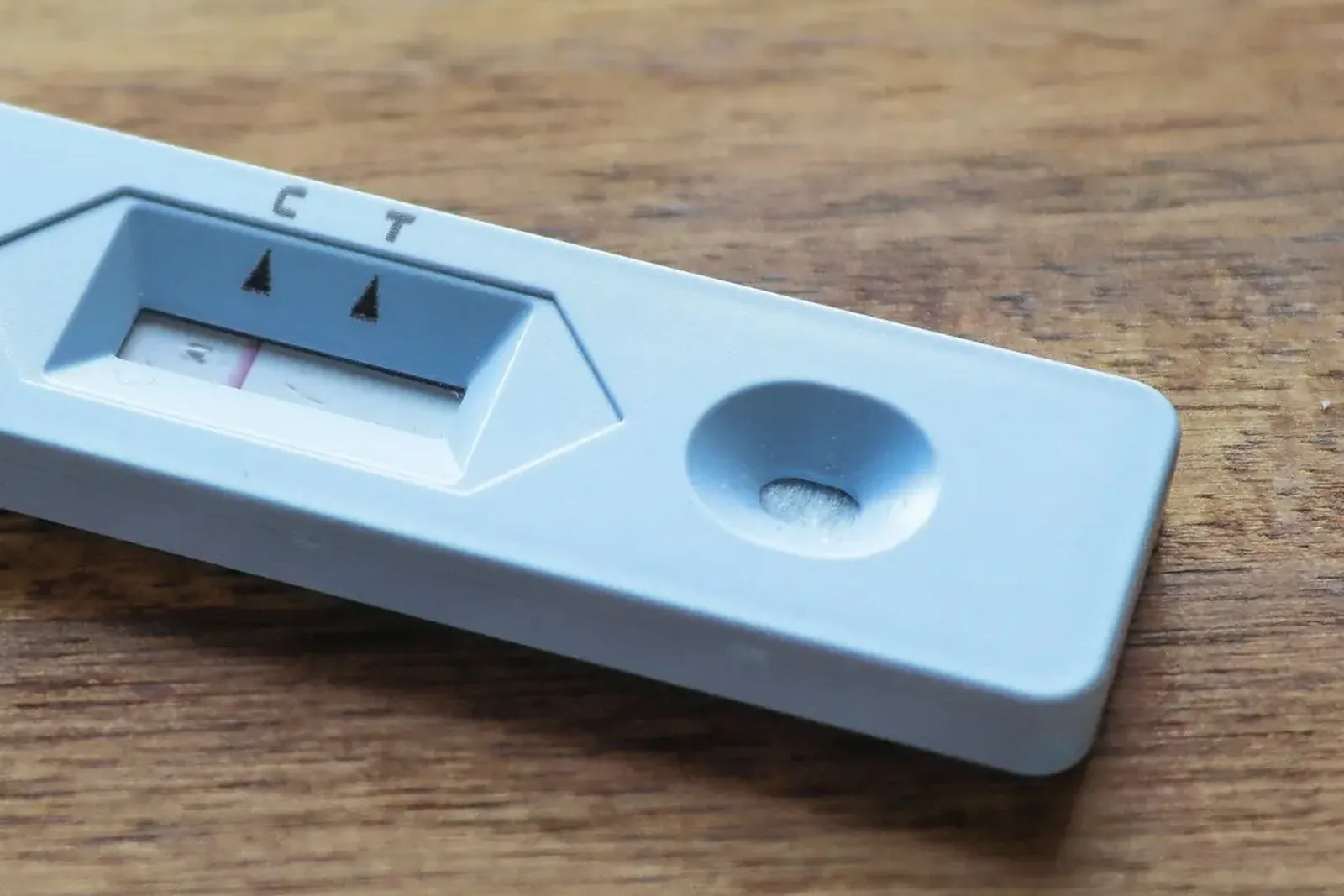
Using one takes a few minutes. Collect urine in a clean cup and test it straight away, because “it is preferred to use fresh urine” (Dis-Chem product notes). Dip the strip to the marked line or drop urine into the well, lay it flat, and read it at the time printed on the insert. A strip left on the counter for an hour can show lines that mean nothing.
Whether a drug is still there to find depends on the drug, the dose and how often the person uses. Our guide to how long drugs stay in your system gives the windows drug by drug.
How do you read a drug test result?
Look at each drug’s window separately. Two lines, one at C (control) and one at T (test), mean negative for that drug. One line at C only means positive. No lines at all means the test has not worked and you need a new one.
| What you see | What it means |
|---|---|
| Line at C and line at T | Negative: below the cut-off |
| Line at C and a very faint line at T | Close to the cut-off: retest or confirm another way |
| Line at C only | Positive: screen above the cut-off |
| No lines | Invalid: use a new test |
The faint line is where most people get stuck, because the logic runs backwards: a line, however pale, points towards negative. The Clicks insert adds that “a very feint line in the Test (T) region indicates that the drug in the sample is near the cut-off level for the test”, and the sample “should be re-tested or confirmed with another method”. More on faint lines and invalid results is in drug test results explained.
How accurate are home drug tests?
Accurate enough to screen, not enough to act on alone. “No drug test of this type is 100% accurate,” the FDA’s page on home drug tests (last updated in 2018) says, and how you did the test, how the urine was stored and what the person ate or drank can all change the result.
A few traps matter more than the rest:
- A screen tests for drug groups. “Only drug classes are tested for (e.g. opiates), NOT the specific drug” (Lancet). A codeine painkiller and heroin can light up the same opiate window.
- Some medicines give false positives. Stocrin, an antiretroviral, “can give a false-positive cannabis result with certain test systems” (Lancet).
- A clean strip can still miss use. “A negative test does not say that the person does not use drugs” (Lancet). The drug may be off the panel, below the cut-off or already gone.
- A positive cannot tell you when the drug was taken. A urine test shows nothing about “the length of time since last ingestion, overall duration of use, or state of intoxication” (NIDA).
Urine, saliva, hair or blood: which drug test should you use?
At home, urine. All three pharmacy kits are urine tests, they are the cheapest, and they cover the drugs most often behind a family’s worry. Saliva, hair and blood answer different questions and mostly mean a laboratory.
Saliva tests show recent use and are easy to collect under supervision. In the US, home tests in “urine or saliva” are sold in pharmacies (NIDA); here, saliva kits come mostly from medical suppliers, and “testing laboratories that can process saliva samples are not readily available” (Lancet), so a positive saliva screen is harder to confirm. Hair and blood samples are taken at a pathology lab such as Lancet or Ampath: hair looks further back, blood at right now.
For a parent, the order is simple: a urine kit at home, then the lab if the strip is positive or the worry will not go away.
Can a home drug test be cheated?
A home strip can be fooled, a laboratory much less easily. “Adulterated urine samples may produce erroneous results,” the Clicks insert warns, and laboratories check “the temperature of the urine sample and for the presence of adulterants” to catch exactly that (Lancet).
The useful part for a family is spotting tampering. Be in the room or right outside it, use a cup you supplied, and test straight away. Urine that looks like water, is cold to the touch or produces an invalid strip twice is a result in itself. Detox drinks and “clean urine” sold online are aimed at the dilution and swapping that a laboratory is set up to find, so a lab sample is the honest answer to any doubt.
If someone goes to that much trouble to pass a test you set, the effort tells you more than the strip would have.
What should you do if the test is positive?
Do nothing drastic yet. “Take no serious actions until you get the laboratory’s result,” the FDA advises, and send a urine sample to a laboratory, because certain foods, supplements, drinks and medicines can affect a home result.
A laboratory confirmation “will identify the specific drug present”, or show that the home screen was a false positive (Lancet). Before the sample goes in, write down every medicine the person takes, including ARVs and cough or pain tablets with codeine.
Then keep the result in proportion. A confirmed positive shows that a drug was used. It “can’t diagnose a drug use disorder (addiction)” (MedlinePlus). What tells you how far things have gone is the pattern around the test: sleep, money, school or work, mood, the friends you no longer meet. A first experiment and a daily habit can produce the same line on the same strip.
A negative deserves the same calm. If the strip is clean but what you see at home has not changed, trust what you see.
How do you talk to your child or partner about a drug test?
Talk before you test, at a calm moment, and lead with what you have noticed rather than with the strip. A test sprung on someone after a row usually ends the conversation, while a test agreed to as part of a plan can open it.
Some things help in that first talk:
- Pick a time when they are neither high nor coming down, and when you are not angry.
- Describe what you have seen: “you have not slept properly for a week”, “money has gone from my purse”. Facts are harder to argue with than labels.
- Ask what the drug does for them. Sleep, confidence, numbing a bad stretch: the answer is usually the real problem.
- With a teenager, agree on the rules and consequences together with the other parent first. With an adult partner, a test only means something if they agree to it.
- Do not threaten what you will not carry out.
Our guide on how to talk to a loved one about rehab goes further into what to say and what to leave out.
When should a family call a treatment centre?
When the test confirms what the house already knows: use most days, promises to stop that do not hold, money disappearing, mood swings or paranoia, or drugs mixed with drinking. One positive strip does not decide that. The pattern does, and a conversation with people who see it every day helps you read it.
Testing is part of how we work too. At our centre in Lakeside, Cape Town, clients take nine-panel urine strips (cannabis, alcohol by EtG, benzodiazepines, opioids, methamphetamine, amphetamines, cocaine, MDMA and methadone) and a breathalyser on arrival, at random during the stay, after they leave and whenever there is a reason to check. What we add is what comes after a result: admission that can be immediate and typically happens within three days of first contact, and treatment for the drug and for the anxiety, depression or trauma under it on one plan, with Ruby Weber, our psychologist, leading the psychological side.
If alcohol or tablets such as Xanor are in the picture, stopping suddenly can be dangerous. Message us and we will tell you whether a medical detox is needed and arrange it, with 24-hour nursing supervision during detox. Admission can be immediate and typically happens within three days of first contact. More on how that works is on our page on drug addiction treatment in Cape Town.
What else do parents ask about drug test kits?
Dis-Chem and Clicks both sell five-panel urine kits, in store and online, and online first-aid suppliers sell bigger cups, up to 12 panels. For a laboratory test, go to a pathology collection point such as Lancet or Ampath.
Yes. Tik is methamphetamine, which the Clicks kit (mAMP) and the Dis-Chem Medic panel (MET) both screen for. Our page on what tik is covers the signs to look for alongside a test.
This article is general information, not medical advice.
Sources
- Dis-Chem: Drug Test category and product pages for the Medic 5-drug Test Panel and Homemed 5 Panel Device, prices as listed on 5 October 2026
- Clicks: 5-Drug Multitest 1 Panel, product page and insert, price as listed on 5 October 2026
- Oxyaider: Drug Test 12 panel cup, price as listed on 5 October 2026
- US Food and Drug Administration: Drugs of Abuse Home Use Test (updated 2018)
- National Institute on Drug Abuse (NIDA): Drug testing (2023)
- MedlinePlus: Drug testing (2025)
- Lancet Laboratories: South Africa Guide to Drug Testing (June 2015, PDF)
- South African Medical Research Council: SACENDU brief, July to December 2024 (PDF)
A test gives you a fact. We help you decide what to do with it.
A free, confidential first call of 20 to 40 minutes by WhatsApp, video or phone. Tell us what the strip showed and what you see at home. We reply the same day, and admission can be immediate.
Free first conversation of 20 to 40 minutes, by WhatsApp, video or phone. We reply the same day.

Leave a request for consultation
Tell us a little about the situation. The first conversation is free and confidential, and we reply the same day.