

Drug test results explained: what do AMP, MET and OPI mean?
What AMP, MET, OPI, MOP, COC, THC, BZO and MQL mean on a urine drug test, which Clicks and Dis-Chem kits test for what, how to read a faint line, false positives and what to do after a positive.

On a urine drug test, AMP means amphetamines, MET (also printed as mAMP or T1K) means methamphetamine, the drug South Africans call tik, and OPI or MOP means opiates such as heroin, morphine and codeine. A line next to a code means that drug was not found above the kit’s cutoff; no line means a preliminary positive. The 5-drug kits sold at Clicks and Dis-Chem do not test for CAT or mandrax.
Holding a result you did not expect? Message us for a free, confidential call with our team in Cape Town. We reply the same day.
What do AMP, MET and OPI mean on a drug test?
AMP means amphetamines, MET means methamphetamine and OPI means opiates. Each code sits next to its own strip on a urine cassette or dip card, and each strip answers one question: was there more of that drug in the urine than the kit’s cutoff?
AMP looks for amphetamine, the stimulant sold as “speed”. MET looks for methamphetamine, which is crystal meth, or tik in South Africa. The Clicks kit labels this strip “T1K (mAMP)”, so a parent reading T1K is reading the tik strip. The Clicks kit insert sets both at 1,000 ng/mL (Clicks).
OPI, MOP and MOR are three names for the same strip, the one that reacts to morphine. Heroin and codeine both break down into morphine in the body, which is why Clicks prints “Heroin (OPI)” on its box. The cutoff on the Clicks insert is 2,000 ng/mL, the same level the US uses for codeine and morphine in workplace testing (49 CFR 40.85).
A missing line on any of these strips is a screening result. It says the drug crossed a threshold. It does not say how much was taken, when, or whether the person has a problem.
What do the other drug test codes mean?
The other codes you are likely to meet are COC for cocaine, THC for cannabis (dagga), MDMA for ecstasy, BZO for benzodiazepines, BUP for buprenorphine and MQL for mandrax. Pharmacy kits in South Africa test for five drugs each, and which five depends on the box.
Three kits were on sale on 5 October 2026: the Clicks 5-Drug Multitest at R99.99, the Medic 5-drug Test Panel at Dis-Chem for R79.99 and the Homemed 5 Panel Device at Dis-Chem for R119.99.
| Code | What it looks for | Typical urine cutoff | On SA pharmacy kits |
|---|---|---|---|
| AMP | Amphetamine (“speed”) | 1,000 ng/mL (Clicks insert) | Medic, Homemed |
| MET, mAMP, T1K | Methamphetamine (tik) | 1,000 ng/mL (Clicks); 500 or 300 on some lab cups | Clicks, Medic |
| OPI, MOP, MOR | Morphine: heroin, codeine | 2,000 ng/mL (Clicks) | Clicks, Medic, Homemed |
| COC | Cocaine | 300 ng/mL (Clicks) | Clicks, Medic, Homemed |
| THC | Cannabis (dagga) | 50 ng/mL (Clicks) | Clicks, Medic, Homemed |
| MDMA | Ecstasy | set by the kit insert | Clicks, Homemed |
| BZO | Benzodiazepines, such as alprazolam (Xanor) | 200 or 300 ng/mL on lab cups | none |
| BUP | Buprenorphine | 10 ng/mL on lab cups | none |
| MQL | Methaqualone (mandrax) | 300 ng/mL (Ampath) | none |
| CAT | Methcathinone (cat) | lab test only, by LC-MS/MS | none |
Cutoffs for AMP, MET, OPI, COC and THC come from the Clicks kit insert; the lab-cup figures for MET, BZO and BUP come from a Thermo Fisher multi-drug cup insert, where MQL is also listed at 300. Codes such as KET (ketamine), BAR (barbiturates) and MTD (methadone) appear on larger lab cups; none of the three pharmacy kits lists them.
Can a home drug test detect CAT or mandrax?
No. None of the pharmacy kits sold at Clicks and Dis-Chem tests for CAT or mandrax, and even Ampath’s standard 10-panel lab screen leaves them out: “This panel does not include Cat, Ecstasy or Mandrax” (Ampath, July 2024). They have to be asked for separately.
CAT, the methcathinone sold in South Africa (our guide to cat and mephedrone in South Africa covers the drug itself), is confirmed at Ampath only by LC-MS/MS, a mass-spectrometry method run in the laboratory. There is no rapid strip for it on a pharmacy shelf.
Mandrax is easier for a lab. Ampath screens methaqualone by immunoassay with a cutoff of 300 ng/mL (Ampath), and its 2024 leaflet gives a urine detection window of 90 to 225 hours. If you suspect mandrax or cat at home, a clean result on a 5-panel card tells you nothing about either.
How do you read the lines on a drug test?
Check the C (control) line first, then each code: a line in the T region means negative for that drug, and no T line means a preliminary positive. It works the opposite way to a pregnancy test, which catches many people out.
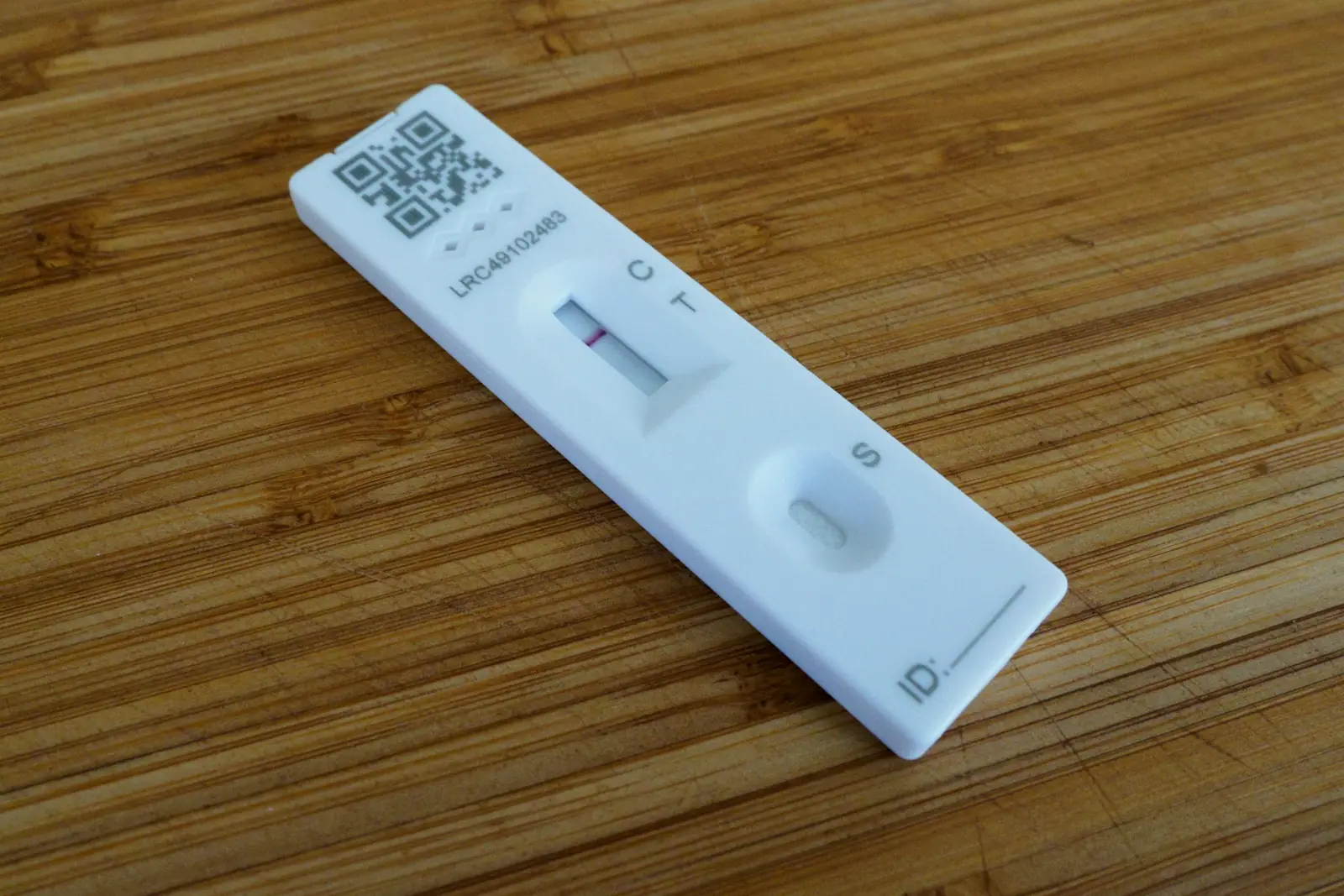
The reason is how the strip is built. Each T line is drawn by a reagent that the drug blocks. When the drug is absent or below the cutoff, the line forms. When there is enough of the drug in the urine, the line does not appear.
So a card with a C line and a line beside every code is clean on all five. A card with a C line and nothing beside COC is a preliminary positive for cocaine and clean on the rest. Read it in the time window printed on the insert: lines that appear or fade hours later mean nothing. And any positive goes to a lab, as the Clicks insert itself says: “any positive test result should be followed up with a laboratory test in order to confirm results”.
What does a faint line or an invalid result mean?
A faint T line still counts as a line, but it means the drug level sits close to the cutoff, so treat it as borderline and test again. An invalid result means the card failed, not the person, and the only fix is a new test.
On the faint line, the Clicks insert is specific: “a very feint line in the Test (T) region indicates that the drug in the sample is near the cut-off level” (Clicks). Near the cutoff can mean a small amount, use several days ago, or very diluted urine. Repeat the test on another day with a first-morning sample, or send the urine to a lab, which gives a number instead of a line.
On invalid results, the insert reads: “If there are no visible colour lines, the result is invalid”. The same applies if the C line is missing while other lines show. Usually the card got too little urine, was dipped too deep or was out of date. Use a new one. An invalid card is not a positive, and it is not proof that anyone tampered with the sample.
Why do cutoffs differ between drug test kits?
Because each manufacturer chooses its own threshold, the same urine sample can be positive on one kit and negative on another. Clicks sets methamphetamine at 1,000 ng/mL; multi-drug cups from Thermo Fisher come in versions at 1,000, 500 or 300 for the same drug (Thermo Fisher).
Workplace rules use their own numbers again. The US federal initial cutoff for amphetamine and methamphetamine is 500 ng/mL (49 CFR 40.85), half the level on the Clicks card.
A lower cutoff picks up smaller amounts, so it stays positive for longer after the last use (see how long drugs stay in your system). A negative home test and a positive work or school test can both be right, because the two kits measure against different lines. Before you compare results, compare the cutoffs printed on each insert.
What can cause a false positive on a drug test?
Some cold and flu medicines, a few prescription drugs and certain foods can trigger a screening strip. False positives happen when the test “reacts with other chemicals in your body from certain over-the-counter medicines, prescriptions, and foods” (MedlinePlus).
The amphetamine and methamphetamine strips are the usual suspects. A review of published reports found that “false-positive results for amphetamine and methamphetamine were the most commonly reported” (Brahm et al., 2010). Ampath names pseudoephedrine, ephedrine, phenylephrine and labetalol among the triggers, along with bupropion and trazodone (Ampath). Pseudoephedrine and phenylephrine are common in over-the-counter decongestants.
On cannabis strips, Ampath lists efavirenz, an antiretroviral, as cross-reacting with some brands, which matters in a country where so many people take ARVs. Hemp foods, by contrast, are “extremely unlikely to cause a positive urine test”, according to the same Ampath bulletin.
Can CBD, poppy seeds or De Witt’s Pills make you fail a drug test?
CBD oil can make a cannabis strip positive, poppy seeds rarely can at the usual 2,000 ng/mL cutoff, and for De Witt’s Pills there is no published case either way. Whichever applies, tell the person reading the result.
CBD oil is the likeliest of the three to cause trouble. In a 2021 trial, 7 of 14 people (50%) taking full-spectrum CBD oil for four weeks tested positive for the cannabis metabolite THC-COOH (JAMA Psychiatry, 2021). “Full spectrum” means some THC is in the bottle, and the amounts are not small: a German market study found more than 30% of CBD products would supply over 2.5 mg of THC a day (Sports, 2019).
A positive from poppy seeds is rare, but possible at the 2,000 ng/mL cutoff. Ampath’s bulletin says poppy-seed positives “will not occur” at that workplace level. A 2026 study of poppy-seed baked goods found that at the same cutoff, codeine was still detectable at 48 hours in a single participant (Journal of Analytical Toxicology, 2026).
De Witt’s Pills come up often in South African searches. The pack sold at Dis-Chem lists two ingredients, dry buchu extract and bearberry extract (Dis-Chem). There is no published report of them causing a positive drug test, and none showing they cannot. If you take them, or any medicine, say so before the test and to whoever reads the result.
What can a negative drug test miss?
A negative pharmacy test clears only the five drugs on that card, above that card’s cutoffs, within the days those drugs stay in urine. Benzodiazepines, mandrax, cat, fentanyl and alcohol all sit outside its view.
Ampath notes that buprenorphine, fentanyl, methadone and oxycodone “are not detected by routine opioid screening tests” (Ampath), so a clean OPI strip says nothing about them.
If what you have seen at home, the sleep, the mood, the missing money, does not fit a clean result, believe what you have seen. Pick the kit to match the drug you suspect (our guide to drug test kits in South Africa compares them), or go to a lab panel that covers it.
What should you do after a positive drug test?
Confirm it in a lab before you act on it, then talk when everyone is calm. The FDA tells home testers to “take no serious actions until you get the laboratory” result (FDA). Ampath says the same from the lab side: a screening positive “is therefore considered presumptive and must always be confirmed”.
Four steps after a positive result
-
Keep the sample, get it confirmed
A lab confirmation names the exact substance and rules out a cold tablet or an ARV.
-
Ask what they take
Medicines, CBD oil, anything from the pharmacy. Ask before the lab result, not after, so it is a question and not a trap.
-
Talk when neither of you is angry
Lead with what you are worried about, not with the test. Our guide on how to talk to a loved one about rehab covers what to say and what to leave out.
-
Keep it private
South Africa’s school drug-testing guide sets the standard: “only the learner and his or her parent/guardian must be informed of the result” (Department of Basic Education). Home deserves the same discretion.
A confirmed result tells you a substance was there. It does not tell you whether this was one party or a habit that has taken over, and that is the question families most need answered. Our counsellors work through it with you: how often, for how long, what else is being used, what has changed at home and at school or work.
If it does come to treatment at our centre in Lakeside, Cape Town, admission can be immediate and typically happens within three days of first contact. Testing stays part of the work there: nine-panel urine strips and a breathalyser on arrival, at random during the stay and after leaving, so a result is something to talk about rather than a verdict.
What else do people ask about drug test results?
THC is the cannabis strip. It looks for a breakdown product of the active ingredient in dagga, and on the Clicks kit the cutoff is 50 ng/mL. All three pharmacy kits sold in South Africa include it.
No. A strip only says above or below the cutoff. A laboratory can measure the actual concentration, which is one more reason to send a positive home result for confirmation.
Yes. Home kits are screening tests, and decongestants, some antidepressants and some ARVs can set off a strip. That is why every positive is treated as preliminary until a lab confirms it.
No. None of the Clicks or Dis-Chem 5-drug kits lists alcohol. Drinking is checked with a breathalyser or a separate alcohol test, and our page on how long alcohol stays in your system covers the timings.
T1K is the label Clicks uses for its methamphetamine strip, the same strip other kits call MET or mAMP. In South Africa that means tik.
This article is general information, not medical advice.
Sources
- Clicks: 5-Drug Multitest 1 Panel, product page and insert (accessed 5 October 2026)
- Dis-Chem: Medic 5-drug Test Panel (dip), product page (accessed 5 October 2026)
- Dis-Chem: Homemed 5 Panel Device Drugs of Abuse, product page (accessed 5 October 2026)
- Ampath: Drugs of abuse, leaflet, July 2024 (PDF)
- Ampath: AmpathChat 41, Drugs of abuse screening (PDF)
- Thermo Fisher: One Step Multi-Drug Screen Test Cup, package insert (PDF)
- US Code of Federal Regulations, 49 CFR 40.85: drug testing cutoff concentrations
- US Food and Drug Administration: Drugs of abuse home use test
- MedlinePlus: Drug testing
- Brahm NC et al., Commonly prescribed medications and potential false-positive urine drug screens, American Journal of Health-System Pharmacy (2010)
- JAMA Psychiatry (2021): urine THC-COOH after four weeks of full-spectrum CBD oil
- Sports (2019): THC in CBD products on the German market
- Journal of Analytical Toxicology (2026): urine opiates after poppy-seed baked goods
- Dis-Chem: De Witt’s Pills, product page (accessed 5 October 2026)
- Department of Basic Education: Guide to drug testing in South African schools (PDF)
A positive test is a fact. What it means is the next conversation.
A free, confidential first conversation by WhatsApp, video or phone. Admission that can be immediate and typically happens within three days of first contact.
Free first conversation of 20 to 40 minutes, by WhatsApp, video or phone. We reply the same day.

Leave a request for consultation
Tell us a little about the situation. The first conversation is free and confidential, and we reply the same day.