

How do you know if you’re addicted to cocaine?
How do you know if you are addicted to cocaine? Eight signs, what cocaine does to your heart, brain and mood, comedown vs withdrawal, emergency signs, and how it is treated.

In short
- You are probably addicted to cocaine if you keep using more than you planned, cannot stop at the weekend, and feel flat and low for days afterwards. Snorted, a line lasts about 45 to 90 minutes, which is why one line is so hard to keep to one line.
- Cocaine raises heart rate, blood pressure and body temperature within minutes. With regular use it damages the heart muscle and roughly doubles the odds of stroke. Anxiety, paranoia and low mood often follow.
- Coming off cocaine is hard. The MSD Manual describes weeks to months of low mood, tiredness and poor concentration, and a strong urge to use again. The depression “requires close supervision and treatment”.
- Clinical guidelines put therapy first for cocaine addiction. Renewed Life Center in Lakeside, Cape Town, treats it residentially, with the low mood on the same plan. Admission can be immediate, typically within three days.
Worried about your own use, or someone else’s? Book a free, confidential call. Twenty to forty minutes, we reply the same day, and a relative can make the call.
Cocaine rarely looks like a problem from the inside. It starts at a party, then it is a Friday thing, then Friday and Saturday, then a Wednesday because of a deadline. Nobody around you is worried, because many of them are doing it too. This page is for the moment you start to wonder whether you are still the one deciding.
If you are reading this about a partner, a son or a daughter, the second half of the page is for you: what you can see from outside, and what to do about it.
What are the signs of cocaine addiction?
The clearest signs are loss of control and the crash. You use more than you meant to, you have tried to cut down and could not, you spend money you did not plan to spend, and the days after leave you low, exhausted and irritable. Needing more to get the same effect, and using to fix the comedown, are the signs that it has become dependence.
Eight signs people recognise in themselves
- One line turns into the whole bag, most times.
- You have promised yourself “not this weekend” and used anyway.
- You need more than you used to for the same effect.
- You drink more because of cocaine, and use cocaine to drink more.
- The money is a problem, or you have started hiding what you spend.
- Monday and Tuesday are a write-off: flat, anxious, short-tempered.
- You have started using alone, or on weekdays.
- You feel you cannot enjoy a night out, or get through a hard week, without it.
If you recognise two or more of these from the past year, take it seriously, and talk it through with someone who assesses this for a living.
Comedown, withdrawal or addiction: what is the difference?
A comedown is the crash after one session. Withdrawal is what regular use leaves behind when you stop: weeks of low mood, tiredness and cravings. Addiction is the pattern that keeps you going back despite both. They blur into each other, which is why so many people mistake the third for the first.
| Comedown | Withdrawal | Addiction | |
|---|---|---|---|
| When | Hours to a day or two after using | After regular use stops | A pattern over months |
| How long | Usually a day or two | Several weeks to months | Until it is treated |
| What it feels like | Tired, flat, anxious, cannot sleep then cannot wake | Low mood, sleepiness, hunger, poor concentration, strong cravings | Using despite money, health, work or relationships suffering |
| What helps | Sleep, food, no more cocaine | Structure, support, treatment of the low mood | Treatment, usually with the underlying problem on the same plan |
Withdrawal and duration from the MSD Manual Professional Edition, Cocaine.
According to the MSD Manual, withdrawal from heavy cocaine use “is characterized by somnolence, difficulty concentrating, increased appetite, and depression”, the symptoms “can last for several weeks to months”, and “many people feel a strong urge to resume use after a period of withdrawal”. That last point is where most attempts to stop come unstuck.
Why does cocaine get hold of people so quickly?
Because it is short. Snorted, cocaine takes effect in 3 to 5 minutes, peaks at 20 to 30 minutes and wears off within 45 to 90 minutes, according to the MSD Manual. The drop at the end is what makes the next line so tempting, so the habit gets rehearsed several times in a single night.
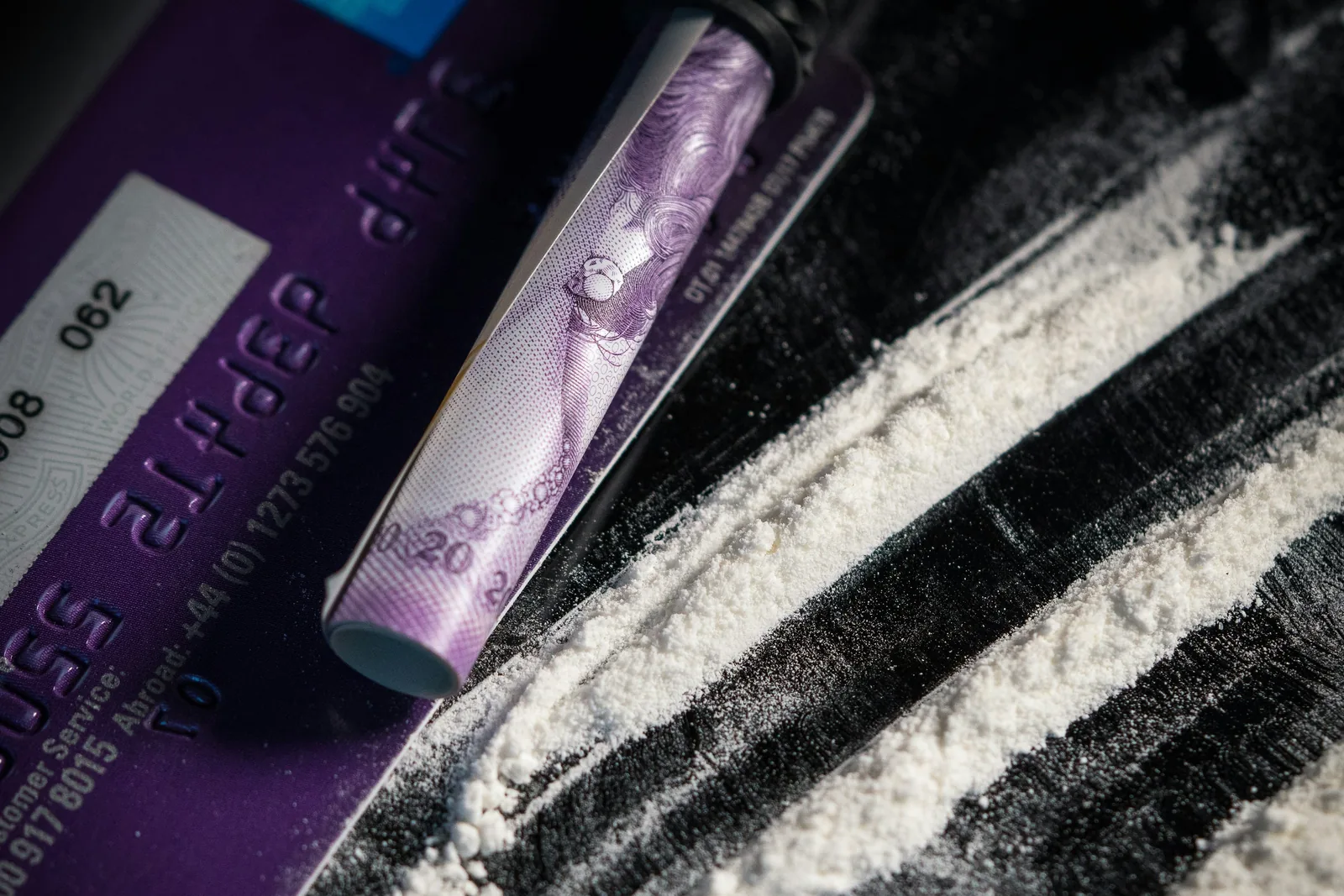
It also works on exactly what a busy, successful life runs short of: energy, confidence and a feeling of being on top of things. People rarely say that part out loud. For many, cocaine has less to do with the party than with getting through the week, the client dinner or the silence at home, and if that goes untreated the reason to go back is waiting on Monday.
What does cocaine do to your body?
In the first hour it speeds everything up: heart rate, blood pressure, body temperature, alertness and confidence. Over months it wears on the heart, the brain, the nose or lungs and the mind. NIDA puts it plainly: cocaine has “significant and well-recognized toxic effects on the heart and cardiovascular system”, and chest pain that feels like a heart attack sends many users to the emergency room.
| Where | During and just after use | With regular use |
|---|---|---|
| Heart and blood vessels | Racing heart, raised blood pressure, chest pain | Inflamed and weakened heart muscle and aortic tears (NIDA); thickening and scarring of the heart muscle (MSD Manual) |
| Brain | Energy, talkativeness, then restlessness and poor judgement | Higher risk of stroke (NIDA); problems with attention and verbal memory in some heavy users (MSD Manual) |
| Nose and lungs | Blocked or bleeding nose; with crack, coughing and tight chest | Rarely, a hole in the wall between the nostrils (MSD Manual); crack damages the lungs and worsens asthma (NIDA) |
| Mood and mind | Euphoria, then anxiety, irritability and a crash | Panic attacks, paranoia and, with heavy use, psychosis with hallucinations (NIDA) |
| Muscles and kidneys | Overheating, agitation, tremor | In severe toxicity, muscle breakdown and kidney failure if untreated (MSD Manual) |
The stroke risk is not small. A 2026 meta-analysis of 32 studies in the International Journal of Stroke found cocaine use roughly doubled the odds of stroke (odds ratio 1.96), and of bleeding into the brain (2.05).
Then there is what the powder is cut with. Nobody buying a bag knows. In 2009 the CDC found levamisole, a veterinary deworming drug that can wipe out white blood cells, in 69% of cocaine lots seized in the United States.
Smoked as crack, cocaine acts faster and wears off sooner. The effect peaks within 3 to 5 minutes and lasts 15 to 20, which is why crack use turns into a cycle of using again and again through the night. The dependence is the same drug, delivered harder.
How common is cocaine use in South Africa?
More common than it was. In national household surveys, recent cocaine use among South Africans aged 15 and over rose from 0.02% in 2002 to 1.8% in 2017. Among people entering specialist treatment in the first half of 2025, cocaine or crack was the main drug for 3% nationally, with an average age of 33, according to the South African Medical Research Council.
Those figures come from a study of five national surveys covering 89,113 people and from the SACENDU research brief of 2026. The average age is telling. These are adults in their thirties who have been using long enough to need help, not teenagers experimenting.
When is cocaine an emergency?
When someone has chest pain, trouble breathing, a seizure, severe agitation or confusion, or overheats. In a study of 3,946 heart attack patients, the risk of a heart attack was 23.7 times higher in the hour after cocaine use. Chest pain after cocaine is always a reason to call for help.
Emergency: call an ambulance on 10177, or 112 from a mobile, if someone has
- chest pain or pressure, or trouble breathing
- a seizure
- severe agitation, paranoia or confusion
- a very high temperature
Tell the paramedics what was taken, including alcohol. Mixing cocaine with alcohol produces cocaethylene, which is thought to be more toxic to the heart than cocaine alone. More on what happens when you mix cocaine and alcohol.
Why is stopping so hard, and who helps?
Because the crash lands on mood. The low mood after stopping can run for weeks, and it lands on people who were often using partly to escape low mood in the first place. The MSD Manual is direct about it: stopping sustained use “requires considerable assistance, and the depression that may result requires close supervision and treatment”.
This is where treatment makes the difference. At Renewed Life Center, Dr Ruby Weber heads psychology and has more than two decades in the addictions field with international and South African clients. Where depression or anxiety sits under the cocaine, it is treated on the same plan, and a psychiatrist selects medication where it is needed. If low mood ever turns into thoughts of not wanting to be here, the Suicide Crisis Helpline is 0800 567 567, day or night.
The weeks after stopping are when people need the most support. Talk to us, free and confidential. Admission can be immediate, typically within three days, and we reply the same day.
What is the treatment for cocaine addiction?
Therapy. Clinical guidelines recommend psychosocial treatment as the first line for cocaine addiction, as a 2018 network meta-analysis of 50 trials and 6,942 people in PLOS Medicine notes. In practice, treatment builds a week that works without the drug and deals with whatever the drug was doing for you.
That means distance from the people, places and routines tied to using, individual therapy on what sits underneath, group work with people who understand, and a plan for the moments that used to end in a line. In our programme that is individual psychotherapy about three times a week and group therapy five or more times a week in the first phase, with CBT, schema work and DBT, evening recovery meetings, and a written relapse-prevention plan built for your own home.
Weekend use is the easiest pattern to call fine, and every Friday quietly resets the plan. That is where it helps to talk to people who have been through recovery themselves. Craig Duke, our addiction counsellor and recovery coach, has more than twenty years in personal recovery and a UK and Swiss background. John Roberts, our Senior Recovery Specialist, has 39 years in personal recovery.
“Only at weekends” is where it usually starts. Book a free call, free and confidential. We reply the same day.
What can you do if someone you love is using cocaine?
Look for patterns rather than proof: nights that end at dawn, money that does not add up, frequent trips to the bathroom, a runny or bleeding nose, weekends followed by days of irritability and exhaustion. Then talk once, calmly, about what you have seen and how it affects you, not about what they are.
You do not need certainty to ask for advice. You can make the first call to us yourself, and there is a longer guide on how to talk to a loved one about rehab. Family therapy is part of our programme, in person or by video, with a weekly family meeting on Wednesday evenings.
Why do people choose Renewed Life Center for cocaine addiction?
Cocaine is rarely the only thing going on, and here it does not have to be treated on its own. Low mood, anxiety, drinking and whatever the drug was helping you carry are dealt with together, in one house, by people you can name.
One plan for the drug and the mood. Our dual diagnosis work treats the depression that follows cocaine as part of the same treatment, without a separate referral.
Medical cover on site. A resident GP, Dr John Wulz, examines every arrival, and nurses are on duty 24 hours a day. Where alcohol or sedatives are part of the picture, detox happens in the same house.
Treatment runs in phases of one month, then a sober living programme for anyone who wants a slower return, with the same team throughout.
The house is in Lakeside, in Cape Town’s Southern Suburbs, far from the people and places tied to using. Payment is direct, so the clinical picture sets the length of stay, and airport transfers are included both ways for people flying in.
How do you start?
With twenty to forty minutes on WhatsApp, video or phone, free and confidential. A clinical assessment of 45 to 90 minutes follows within three days, and admission can be immediate, typically within three days of first contact.
How you get here
-
A free first call
No obligation, no judgement. A partner or parent can make it.
-
Clinical assessment
What you use, how often, what else is going on, and what has happened when you tried to stop.
-
Admission
Can be immediate. More on drug addiction treatment in Cape Town.
Write to us about the cocaine, or book a free, confidential call straight away.
Questions people ask
Yes. Addiction is about loss of control and harm, not the day of the week. If weekends keep getting longer, or you cannot stop once you start, the pattern is already there.
After a single session, usually a day or two. After regular heavy use, the low mood, tiredness and cravings of withdrawal can last several weeks to months.
The first weeks need close support, because of the low mood, tiredness and cravings. If you also drink heavily or take sedatives, medical detox may be needed for those. The assessment decides.
South African schemes cover in-hospital treatment for substance dependence for up to three weeks a year. At Renewed Life Center you pay directly, so the length of stay follows the clinical picture rather than a scheme’s limit.
Yes. International clients are a primary focus of our practice, and distance from the people and places tied to using is part of what helps. British passport holders do not need a visa for up to 90 days.
This article is general information, not medical advice.
Sources
- MSD Manual Professional Edition, Cocaine
- Trends in drug use in South Africa, five national household surveys, 2002 to 2017
- South African Medical Research Council, SACENDU Research Brief, volume 29(1), 2026
- Mittleman et al., Triggering of myocardial infarction by cocaine, Circulation, 1999
- NIDA, Cocaine DrugFacts
- Cocaine use and stroke risk, systematic review and meta-analysis, International Journal of Stroke, 2026
- CDC, Agranulocytosis associated with cocaine use, MMWR, 2009
- Cocaethylene toxicity, review
- De Crescenzo et al., Psychosocial interventions for cocaine and amphetamine addiction, PLOS Medicine, 2018
“Only at weekends” is where it starts. Talk to us now.
A free, confidential call of twenty to forty minutes, for yourself or someone you love. We reply the same day, and admission can be immediate, typically within three days of first contact.
Free first conversation of 20 to 40 minutes, by WhatsApp, video or phone. We reply the same day.

Leave a request for consultation
Tell us a little about the situation. The first conversation is free and confidential, and we reply the same day.